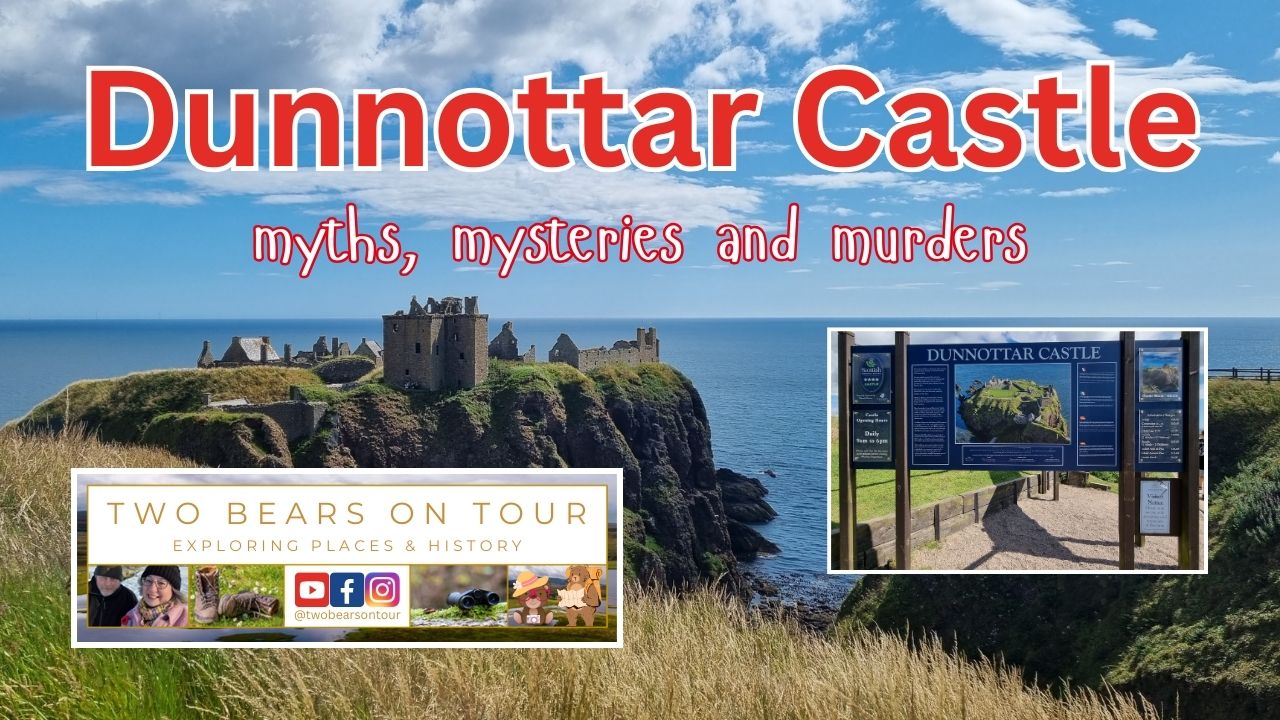
Dramatically perched on an outcrop along Scotland’s northeast coast, Dunnottar Castle was once one of the most important medieval castles in Scotland. Once a bastion of Scottish history, Dunnottar has witnessed many pivotal historical events including sheltering Charles II and the Scottish crown jewels from Cromwell’s invasion. Its ruinous walls have many secrets to tell … Join us as we discover Dunnottar’s fascinating and brutal history.
Dunnottar’s history begins with the legend that St Ninian created a missionary station here in around 400AD. For over 400 years, the castle was owned by the prominent and wealthy Keith family, who were bestowed the title Earl Marischal. Its story ends when they joined the Jacobite cause and were forced to forfeit their estates, including Dunnottar castle in the 1700s. The castle fell from use and was dismantled; its roofs, floors and furnishings sold off to the highest bidder.
Dunnottar is situated in an area known as the Mearns, to the east of the Grampian mountains by Stonehaven. This area was the primary access route from central Scotland to the fertile plains of the Moray Firth and the Highlands beyond. It is strategically positioned at the narrowest point between the mountains and the sea and, as a fortified gateway, Dunnottar could be easily defended.
The rock on which the castle stands is a conglomerate known as “pudding stone”, which is formed by large rocks and pebbles. Melded together it is immensely strong, like cement; its resemblance is likened to raisins in a fruitcake. The rock was once connected to the mainland by a narrow strip of land, which was removed to increase the defensive aspect of the castle. A series of over 200 uneven steps provide the only access and lead up to the only entranceway both in and out of the castle, through the main gate.
The gateway was designed to make hostile visitors feel very unwelcome indeed. Most of the castle was naturally defended from attack by the sea, but the landward side was vulnerable. The grand arched gateway, which was made smaller in the 1600s, was defended with wooden doors, a portcullis and ramparts from which arrows and other missiles could be rained on attackers.
To the right of the gateway is Benholm’s Lodging, a three storey building with wide-mouthed gunloops. These gunloops are of a style that was introduced to Scotland in the 1520s, which suggests that this lodging was built around that time.
Once through the gates, you are faced with four gun loops arranges in a very unusual two-up, two-down formation. These too date from the 1520s. The guardroom behind it is carved into the rock itself and leads through to the ground floor of Benholm’s Lodging where there is a prison cell. Opposite is the gunpowder store which is also surrounded by defensive positions.
The ticket booth is here. It’s not until this point that you need to pay to enter the castle. Access to the castle itself is via two steep covered pends which were also gated and overlooked by defensive positions. Between the two pends is an open passageway with high walls that would also have been very heavily defended. I think it’s fair to say that any intruder trying to gain access to the castle would have found his path incredibly difficult!
The Keep was commissioned in the 1390s and is the most prominent building on the rock. It is a fortified medieval tower house. An unusual straight stone staircase leads to the first floor. Under the stairs is another prison cell.
The kitchen is now on the ground floor having been moved there from upstairs when the adjoining storehouse was built.
The main room is on the first floor and would have been the venue for meals, celebrations, trials and administrative business. The original kitchen was converted into a private chamber but the original kitchen fireplace is still there.
A spiral stair led to the upper floors where the master bedroom and other chambers would have been. A square caphouse at the top gave access to a patrolled parapet walkway.
The storehouse sits between the keep and the smithy. It is a simple two-storey building with a vaulted ceiling on the ground floor. The service staff would have lived upstairs.
Metalwork was essential to such an isolated castle with its own stables so Dunnottar had its own smithy. You can still see the large fireplace and chimney. It was a mark of the castle’s importance that metalworking was carried out on site. The metal would have been transported by boat and hauled up the side of the rock.
Horses were not only a sign of wealth, for residents and visitors to Dunnottar, they would have spared their owners the gargantuan effort of getting to and from the castle. The stables could house up to twelve horses. They also had storerooms for their fodder and saddling. Grooms accommodation was above, which would have been reached by external stairs.
At the centre of the site are the ruins of a comfortable two-storey house. This may have been Waterton’s Lodging. Waterton was a close associate of the 7th Earl Marischal. However, the style of house suggests that it was built in around the 1570s which in turn suggests that it may have originally been the home of the 4th Earl’s eldest son and his wife. It would have had two main rooms on the ground floor and two rooms upstairs. The levels were linked by an attractive circular stair tower with a square caphouse on the top.
The stone chapel was built in the 1500s and replaced an earlier church that was consecrated here in 1276. This earlier church was more than a century older than the keep, but according to legend, that church replaced an even earlier chapel said to have been established by St Ninian.
The small windows in the south wall with their pointed gothic arches are from the church of 1276.
It is traditionally orientated with its altar at the east end. The main entrance in the west gable was rebuilt in the 1500s with a gothic arched window above and a belfry.
Another legend states that in 1297 William Wallace massacred a large English army on this sacred spot. In 1296, King Edward I of England invaded Scotland and so began the 60 years of the Wars of Independence. Edward initially made quick gains but had met resistance and was defeated at Stirling Bridge in September 1297. Legend has it that Wallace trapped a supposedly 4,000 strong English force here at Dunnottar. Wallace is alleged to have shown no mercy, trapping the English in the chapel and setting fire to it. Anyone who didn’t meet his fate this way was driven over the cliffs to certain death. These events are recorded in a book; a biography of Wallace written 200 years after this supposed event by Blind Harry, whose writings are well known for enthusiasm rather than accuracy. There has indeed been a consecrated chapel on this site since 1276 however, there is no evidence of a castle here at that time and no evidence that Wallace trapped 4,000 Englishmen here. No-one knows if this legend is true or not!
Therefore a fire was brought speedily
Which burnt the church, and all those South’ron boys
Out o’er the rock the rest rush’d great noise
Some hung on craigs, and loath were to die
Some lap, some fell, some flutter’d in the sea
And perish’d all, not one remain’d alive.
Between the chapel and the stables is an enclosure which was used to bury the dead. There is only one grave marker which survives which reads “a bairn of nyn years lyes here” giving the date 1685. This date coincides with the Whig prisoners who were held here; it’s thought it may be linked to that event, which we will tell you about later.
During the later years of the castle’s life, the quadrangle was built. It consists three ranges of residential buildings organised around a courtyard.
Near its centre is a large circular enclosure full of water. It is not a well. It is a huge cistern 9.5 m in diameter and 7.6 m deep, designed to collect and store rain water.
The nearest supply of running water is at St Ninian’s Den to the south of the castle. Collecting and winching water from here wold have been exhausting and perilous. Medieval people rarely drank water because of the risk of disease, instead water was brewed into a weak ale, effectively purifying it.
If necessary, it was possible to leave the castle rock via a narrow archway from the quadrangle. The Water Gate gave access to a, now eroded, perilous pathway down to a small bay with a cave where boats could be moored.
The West Range was built in the 1580s. It provided extra accommodation but it also had a most fashionable addition – a gallery.
The Silver house was probably so-called because it contained a strongroom in which valuables could be stored. It may even have been where the Honours of Scotland were stored in 1651-1652 during Cromwell’s siege of the castle.
The west range had an unusual arrangement. On the ground floor, there are seven almost identical chambers, side by side, each one with its own door, two windows and a fireplace. They may have been accommodation for servants or for visitors. Access to the first floor is via a staircase in the Silver house. This upper floor housed the very fashionable gallery which was richly decorated and used for indoor exercise, music, dancing and for displaying grand artworks and paintings. There was also a retiring room which connected with the drawing room of the north range.
Up the Great Stair, are the more prestigious rooms:
the Dining Room – an expansive room with large windows on both sides and a great fireplace meant the Earl could entertain on a grander scale that the hall in the keep would have allowed. It had a retiring room with a latrine and a gun loop.
The drawing room. Restored by Lady Cowdray in the 1920s with refurbishments designed to commemorate the eight-month siege of the castle by Cromwell’s army in an attempt to steal the Honours of Scotland. The carving above the fireplace pays tribute to George Ogilvy and his wife Elizabeth Douglas and Anne Lindsay, who played key roles in preserving the Honours.
In the early 1600s, the east range was completed and provided the Earl and the Countess with their own Suites on the upper floor.
The countess suite would have been very comfortable with an outer receiving room, a private bedroom, and a closet. There are two windows overlooking the quadrangle and a curious secondary access via an external stone stair at the east end of the chapel, which presumably connected to her chambers via a timber gantry. Given that the countess eventually eloped with her long-term lover, Sir Alexander Strachan of Thornton, taking with her much of the Earl’s wealth, could this staircase have been his secret access to her chambers?
The marischal’s suite is thought to have been built later in the 1640s. This would have been another handsome suite with a private chamber and a bedroom. It has tall chimneys and stunning sea views.
There are two original stone carvings set into the west wall of the private chamber: a sundial, which was moved here from the lower pend during restorations in the 1920s; and, in it’s original position above the fireplace, is the coat of arms of the 7th Earl and his wife, Countess Elizabeth Seaton. It is dated 1645.
The Whigs Vault sits below the Marischal suite and is the site of Dunnottar’s most shameful episode. Originally built for storage and defence, it slopes down toward the cliff edge and is fitted with gun loops. However, in 1685, this space was used for a much more sinister purpose; a prison for political prisoners. At the height of the period known as The Killing Time, One hundred and sixty-seven religious rebels, known as Covananters, were confined in the Whig’s Vault from 24th May until end July.
When Charles II was restored to the English Throne in 1660, he turned his back on his former allies, the Covananters. He imposed episcopacy – church rule by Bishops – upon his, mainly presbyterian, Scottish subjects, ordering their imprisonment, torture and execution without trial. When Charles II died, his catholic brother, James VII caused great anxiety to protestants. There was a rebellion against the King lead by the Earl of Argyll. Supported by the Covananters, the Whigs – anti-catholic and anti-royalists became a major political party. They were arrested and made to swear allegiance to the King. Those that didn’t were taken to Donnottar to await transportation overseas.
Dunnottar’s presbyterian prisoners, were placed in the Whig’s vault with minimal food, water, privacy or sanitation.
122 men, 45 women and possibly some children were imprisoned in the vault: 37 signed the oath; 5 died; 25 escaped but 15 were recaptured; 2 fell from the cliff face. After 10 long, miserable weeks, 120 were dispatched on a penal ship to the West Indies; 70 died during the journey.
“They had not the least accommodation for sitting, leaning or lying, and were perfectly stifled or want of air. They had no access to ease nature, and many of them were faint and sickly … The barbarities of their keepers and soldiers were beyond expression.”
Below the dining room was the Great Kitchen. It needed to provide lavish and grand dinners. The fireplace is 3m deep and almost 4m wide and has two domed ovens. There is also an original slop drain and a very worn stone trough. Opposite the kitchen were the storage cellars and a sequence of three rooms: one is another storage cellar. Next is the brewery, a pipeline connected the cistern to the brewery where a simple brewing process transformed water into a weak ale. All of the residents and staff enjoyed this weak brew as a safe alternative to the bacteria ridden water. Beyond the brewery is the bakehouse where all the bread was made. Many people have reported seeing the figure of a young woman dressed in green plaid, a soldier and a deerhound in these, frankly spooky cellars!
As you go towards the exit, take the path through another short pend and you will come to the top floor of Benholm’s Lodging. You’ll pass the Lion’s Den, a hollow carved into the rock which was actually home to a lion! In the 1500s, if you owned an exotic beast, such as a lion, it was seen as a great status symbol and the Earl Marischal did in fact own one. However, his Countess ordered it to be destroyed as it kept her awake during the night. He is said to have responded by acquiring a bear called Black-Beard whom he trained to offer him his paw!
Benholm’s Lodging was probably built for James Keith of Benholm; he certainly lived there. Designed specifically to fit the rock, it is rhomboid in shape and has some fearsome defences in its lower floors which were designed to guard the castle’s main entrance.
Its upper floors were by contrast a comfortable dwelling. The top floor houses an exhibition of the castle’s history and a scale model of the castle itself. There are also photographs of coins dating to various periods that have been found in the castle and its grounds.
Outside, you will see an arched doorway covered with an iron grille. This secondary entrance to the castle is known as Wallace’s Postern. We told you earlier the story of William Wallace holding an army of English soldiers here and burning them in the chapel in 1297. This postern is said to have been the entrance that Wallace used to gain access to the castle. However, there is absolutely no evidence at all that a castle existed here at the time, so this story is almost certainly a myth. The postern now has a new role as a wishing well.
Mary Queen of Scots visited Dunnottar on 5th and 6th November 1562 after her army defeated the Earl of Huntly at the Battle of Corrichie. Huntly had led a rebellion against her. She was just 19 years old, but she showed great resolve and Huntly died on the battlefield. She later had his corpse taken to Edinburgh and tried for treason. Huntly’s son had also tried to kidnap her in an attempt to force her to marry him, but he was caught and beheaded at Aberdeen on 2nd November.
She returned to spend another 2 nights at Dunnottar two years later, in September 1564.
During the first half of the 1600s, Charles wanted Scotland to adopt episcopacy. Many Scots didn’t agree and in 1638 most of them signed the National Covenant embracing Presbyterianism. They became known as the Covananters. Many rebellions took place which led to grim episodes including the one here, in the Whig’s Vault, which we told you about earlier.
The then Earl of Marischal, William Keith joined the Covananters which was led by James Graham, the Marquis of Montrose. However in the years that followed, Montrose switched allegiance and came to Dunnottar with the Royalist Army to attempt to negotiate with the Earl. The Earl refused and Montrose’s vengeance was swift. He savagely ordered the area to be plundered and burned. The Earl held fast in his castle while his barony burned.
Charles I’s troubles didn’t end there. In the mid 1640s Scotland, England and Ireland were in the midst of a civil war known as the War of the Three Nations. Charles I was arrested, tried for treason and beheaded by Parliament in January 1649. Parliament assumed control of Great Britain. Many Scots were appalled by this and they declared that Charle’s son, was King of Scotland, crowing him King Charles II in his absence. Charles arrived in Scotland in 1650 to claim his kingdom making an uneasy truce with the Covananters. His arrival prompted the Parliamentarian army to invade Scotland, their leader – Oliver Cromwell.
Cromwell wanted the Scottish Crown Jewells, known as the Honours of Scotland. But Charles had already had them moved from Edinburgh to Dunnottar to throw him off the scent. The Earl Marischal had been captured and imprisoned in the Tower of London and custody of Dunnottar and the Honours, fell to George Ogilvy of Barras, an experienced soldier and trusted ally of the Earl.
Cromwell came to Dunnottar, but the Parliamentarians lacked the firepower to take the mighty castle by force, so they intercepted supplies to the castle. As winter set in, food became short and desperate missions to gather food had to be undertaken. Months went by. Cromwell’s army had conquered the rest of Scotland, but Dunnottar stood alone and undefeated.
The heavy artillery finally arrived and the castle endured 10 days of gunfire and bombs. They surrendered. But the Honours had already been saved; secretly lowered down the side of castle rock, collected by an incredibly brave serving woman and smuggled to a nearby church where the minister and his wife hid them. They remained there until 1660 when Charles II was restored to the throne in England.
The Drawing Room which we showed you earlier was refurbished in the 1920 and has an inscription above the fireplace honouring those who saved the crown jewells from cromwells hands.
The downfall of Dunnottar starts with the Earls support of the Jacobite cause. The so-called Glorious Revolution which ended the Catholic monarchy. The Earls were loyal Jacobites and fought for the cause at the crucial but indecisive Battle of Sheriffmuir in November 1715. On 30th January 1716, they escorted Prince James, their would-be king to Montrose, where he boarded a ship to France. He never returned.
Their involvement in the Jacobite meant the Earl had to forfeit his estates. By now, Dunnottar had been in the Keith family for over 400 years. The castle fell from use and was dismantled; its roofs, floors and furnishings were sold.
In 1919, the castle was bought by Weetman Pearson, 1st Viscount Cowdray who preserved the castle as we see it today.
 twobearscottage.com