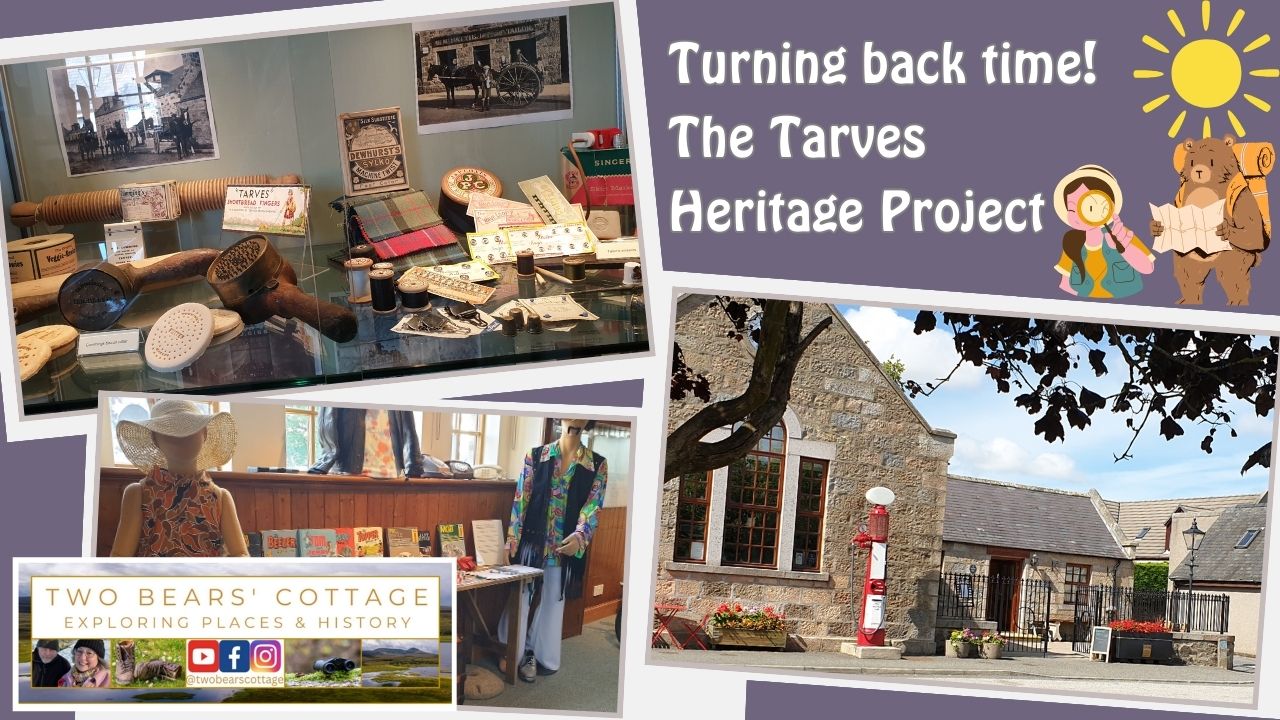

The Tarves Heritage Project was set up in 1992 with the aim of pulling together past and present heritage from the area. The centre lives in part of the old school building and houses displays on themes relevant to the area; farming, domestic life, shops, local trades, the school, the kirk.
The school building was built in 1837 during the reign of Queen Victoria but it closed in 1911. It has since been used as a boot and shoe factory, a cycle repair shop, and an electrician’s store.
One of the founding members of the project was Dorothy Corbett. She was the only daughter of Willie and Ella, sheep farmers who also sold milk. Dorothy was interested in local heritage and became a founder member of the Tarves Heritage Project. When the old school building came on the market, she had the foresight to recognise the opportunity to restore the schoolroom and create a museum for local artifacts. The legacy of her estate ensured the final renovation of this building.
The Centre is open from April to October and is free to enter. It is staffed completely by volunteers whose local knowledge is second to none and is particularly popular with those tracing their family roots in this area. During the winter months, there is a series of historical talks about the local area which are held in the Centre.
This is the Tarves Bowl. It was produced at Seaton Pottery in Aberdeen and is inscribed as belonging to a Miss Maggie Smith in 1894. It was seen by chance by a Heritage Project volunteer on the Antiques Roadshow in October 2011 when it was purchased from a sale room in Fife. It was subsequently auctioned in Kent. The Heritage Project contacted the auction house, asking if they could buy the bowl back; a sale was agreed and home it came! Also watching the Antiques Roadshow on that day was Louisa Innes, the great grand-daughter of Maggie Smith. Louisa had fond childhood memories of the bowl and also donated the dabware barrel to the project.
The displays are changed regularly; when we visited, there was a distinct 70s vibe and we remembered almost all of the items on display!
There is a school classroom area set out as it would have been in Victorian times which features artifacts from throughout the years. This room was renovated in 2004 and shows meticulous attention to detail in what life would have been like for schoolchildren in the 1800s. The desks are authentic reproductions which were made using the template of just one surviving desk from the old school and are complete with inkwells.
In the entrance area you will see some fine fabric panels. These are “The Triple Hangings”. This beautiful textile artwork was created by people with a link to Tarves and the surrounding area. The panels display local views, buildings, landmarks, animals, flora and fauna, and objects that all have a local story to tell.
Close to the Centre, is a lovely church and churchyard. In the churchyard lies the Tarves Tomb, which was constructed in 1589 for Sir William Forbes and his wife Lady Elizabeth who were Laird and Lady of nearby Tolquhon Castle. The intricate carvings on this stone are fascinating. There are two portrait statuettes: one of Sir William and one of Lady Elizabeth. They are remarkably lifelike and are depicted supporting the beautiful Gothic arch, above which are the couples’ coats of arms and mottos. Sir William is wearing a flat cap, a ruff, a puffed and slashed doublet and knee breeches. Lady Elizabeth is wearing a long embroidered gown with full sleeves and a ruff.
We found our visit to this enchanting little village fascinating and it invoked many childhood memories for us. If you’re ever in this area, we’d encourage you to visit!
 twobearscottage.com